Follow the Wind Home
My 2023 historical novel, Follow the Wind Home, is set in Springfield, Illinois during the Civil War. An uplifting story, it offers a heartfelt message for those who struggle with moving on after loss.
The storyline is easy to follow, and the characters are interesting and engaging. The writing is rich with vivid descriptions that will help you fall in love with the land. The local settings in the book are accurately described, based on extensive research. The book has an epic feel, patterned after the Biblical book of Job and written in the literary style of John Steinbeck and Willa Cather.
Paperback and Kindle versions of Follow the Wind Home can be purchased on Amazon. The hardcover with dust jacket can be purchased on Lulu.
Novel Summary
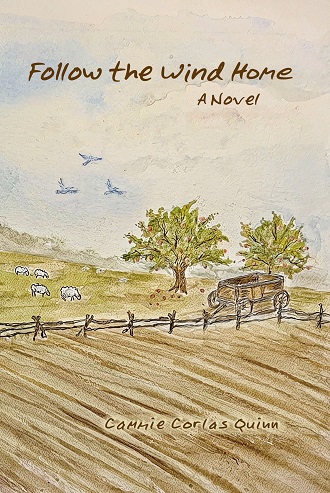
On a wintry day in 1860, Catherine Corlis and Mary Todd Lincoln cross paths in a Springfield, Illinois cemetery while visiting their children's graves. Catherine, shunned by the townspeople after a brothel owner stole her innocence, and Mary, whose husband is running for president, bond over their deep-rooted grief. Mary invites Catherine to call on her.
Before she can answer Mary's invitation, Catherine must find the strength to break the chains of grief that hold her captive to the past. As war descends on the nation, she inherits her uncle's sheep farm one mile from a Union recruiting camp. While signing the land deed, she meets a charming orphan, sixteen-year-old Belle Peters, who bears a remarkable resemblance to Catherine's deceased child.
That night, Belle's teacher, Sister Ann, appears at Catherine's farmhouse and asks Catherine to board Belle, who will soon be graduating from the Ursuline Academy. Catherine latches onto Belle as a replacement for her daughter. She also opens a rehabilitation school for ex-prostitutes at her farmhouse, where Sister Ann and Belle join her as teachers. Catherine writes to Mary Lincoln, sharing her newfound joy.
When brothel owners Hunter and Lucinda Proacher threaten her, and when former school friend Fred Winterford exhibits questionable interest in Belle, Catherine fears she will lose Belle. Additional problems plague her: the loss of her farmhands, a prairie fire, a tornado, and smallpox. When death comes knocking, Catherine struggles to hold onto her school, Belle, and her faith.
Only through Sister Ann's steadfast example and the help of a wandering shepherd, Dandy, is Catherine able to weather the challenges and reconsider Mary Lincoln's invitation on Easter weekend of 1865—the same weekend that President Lincoln is assassinated.
Author Background
Like most of my readers, I've mourned the loss of family members and friends. I've also mourned the loss of a farm that was sold out of our family. I've always found it difficult to "let go" of people and places. After such losses, moving forward is the logical answer, but how does a sensitive heart move forward?
This is the question posed by Follow the Wind Home. How do you move on when you would rather go back? This question is echoed in this poignant quotation from my mother's diary:
"Everything changes and then the traces even disappear. Small pioneer farms are all disappearing into larger expanses for big machines. Some groups of trees are left standing here and there so you know the houses and barns were torn down or bulldozed into a hole. I wonder if any breath of the people who lived there lingers in those vacant places? Does what happened there matter anymore? Does anyone remember? Only God, probably." (Florence Lebel Corlas Diary Entry, January 18, 2003)
While growing up, I was introduced to the legacy of Abraham Lincoln. I went on school field trips to Lincoln historic sites, such as Lincoln's home, Lincoln's tomb, and the Old State Capitol. My parents took our family on summer outings to Lincoln's New Salem, a log cabin village northwest of Springfield.
I developed an admiration for all things Lincoln. When my dad plowed the garden every year, I dreamed of finding a Lincoln letter in the dirt. I even tried to build a log cabin with my dad's tomato poles in our back yard.
At Lincoln Land Community College, I pursued an associate's degree in English and then went on for a bachelor's in English and a master's in history at Illinois State University. For my master's thesis, I researched Springfield, Illinois during the Civil War. For years, I studied the tiny print on microfilm of two daily Springfield newspapers. My master's thesis was published in 1991 by Western Illinois University as a monograph, Lincoln's Springfield in the Civil War.
That research, handwritten on a thousand note cards, served as the historical background for Follow the Wind Home.
Fun Facts About Writing Follow the Wind Home
The main character: I named my main character, Catherine Corlis, after my own great-great grandmother who lived in Springfield before and during the Civil War. She immigrated with her husband, William, from Ireland to Springfield in the 1850s. My only information about their personalities was a few small articles I found in the Springfield newspapers noting their repeated arrests for public drunkenness and fighting in the streets. My favorite newspaper quote about my great-great grandmother is: "Fie on you, Catherine Corlis, and you with a babe at the breast!"
Over the years, the family remained in Springfield into the 20th century. By the time my father was born in 1930, the last name "Corlis" had changed to "Corlas," my maiden name.
The setting: Sunday afternoons at my grandfather's (my mom's dad's) farm in rural Auburn gave me a love for the pungent scents of plowed earth and hay and manure. I purposely set my main character, Catherine, on a farm so that I could write about the land that I love. I chose a sheep farm after learning in my research that large sheep farms were prevalent in Sangamon County during the Civil War. I picked a location near Camp Butler because I had previously researched Civil-War-era Camp Butler and because an Army recruiting camp represented the sort of drastic change that would challenge Catherine.
In the book's epilogue, Catherine's farm along Sugar Creek in rural Auburn is meant to honor my memory of my grandfather's farm in the same general location.
The blue jays: The jays are based off my childhood memory when my family raised baby sparrows in our kitchen. My siblings and I found them in an abandoned nest at the baseball field next to our house. We brought them to the house and begged our mother to let us keep them. A breadbasket with a hand towel became their home. We fed them by dropping pieces of hamburger into their mouths with tweezers. They soon took flight in the kitchen, landing on my dad's shoulders.
The day came when we had to release them into the wild. On our first try, we realized that an overnight rain was soaking their feathers. We brought them back indoors for a later attempt, at which time we let them loose in our crabapple tree. For a couple of days, we spotted them in the yard, but soon they mixed with all the other sparrows. These sparrows were the inspiration for the blue jay subplot in Follow the Wind Home. I chose blue jays (instead of sparrows) with the advice of my naturalist sister, Maureen, who advised me that blue jays would be smart enough to return to the same spot in successive years. (See my mother's recollection of this event in the "Stories" section of this website.)
The Search for Little Dorrit: The chapter in which Little Dorrit escapes on the prairie came from an experience years ago when I joined strangers in a search for a lost puppy. That day, about forty strangers congregated to search through acres of brush for a puppy that had escaped at a rest stop a few miles from my house. Joined by a common purpose and a love for animals, we all became one big family that day.
The Style: I attempted to write the novel in a lyrical style, much like the style of Willa Cather, John Steinbeck, and Frank Norris—all writers whose styles I learned to admire in high school and at Lincoln Land Community College. It's a poetic style that is well-suited to accommodate descriptions of nature.
The Symbolism: The novel is highly symbolic. For example, the wind, the river, the train, and the clock are symbolic of moving forward. Vigils in the cemetery, burying Little Lamb's grave with leaves, concealing Little Lamb's name, and confining Little Dorrit are symbolic of clinging to the past.
Book Discussion Questions
The questions below can be used in a group setting to discuss the novel.
- Do you believe that your love for a deceased loved one will grow cold if you cease going to the grave to mourn him/her?
- Have you left a former home that you still mourn over? How can you heal and move on?
- Which is worse—to hide your grief or to cling to it?
- If you've emerged from a long season of deep grief, will you do anything differently after the death of your next beloved one?
- After a season of profound loss, what do you have left to look forward to on this side of Heaven? Can you make a list?
- Have you ever left loved ones (family or friends) without saying good-bye? Do you regret your hasty departure? Is there something you can do to rectify this?
- Have you ever experienced the blessing of a "lost blue jay" [animal or human] returning to your life after a long absence? Did this encourage you? How?
- When/where have you experienced God's presence in nature?
- Have you met strangers like Dandy who passed through your life and changed you in a profound way?
- Have you lost family or friends, thought that you might never recover, and then experienced the blessing of new family or friends?
- Which is more effective? Your prayers or God's plan?